
들어가기
유엔(UN)과 인구학 연구에서 국제적으로 널리 쓰이는 기준에 따르면 고령화사회(Aging Society)는 65세 이상 인구 비율이 7% 이상~14% 미만인 사회, 고령사회(Aged Society)는 65세 이상 인구 비율이 14% 이상~20% 미만인 사회, 그리고 초고령사회(Super-aged Society)는 65세 이상 인구 비율 20% 이상인 사회를 가리킵니다. 하단 인포그래픽에 따르면, 한국은 2020년대 초, 이미 초고령사회가 되었습니다. 그 이유를 한 번 추측해 보세요.
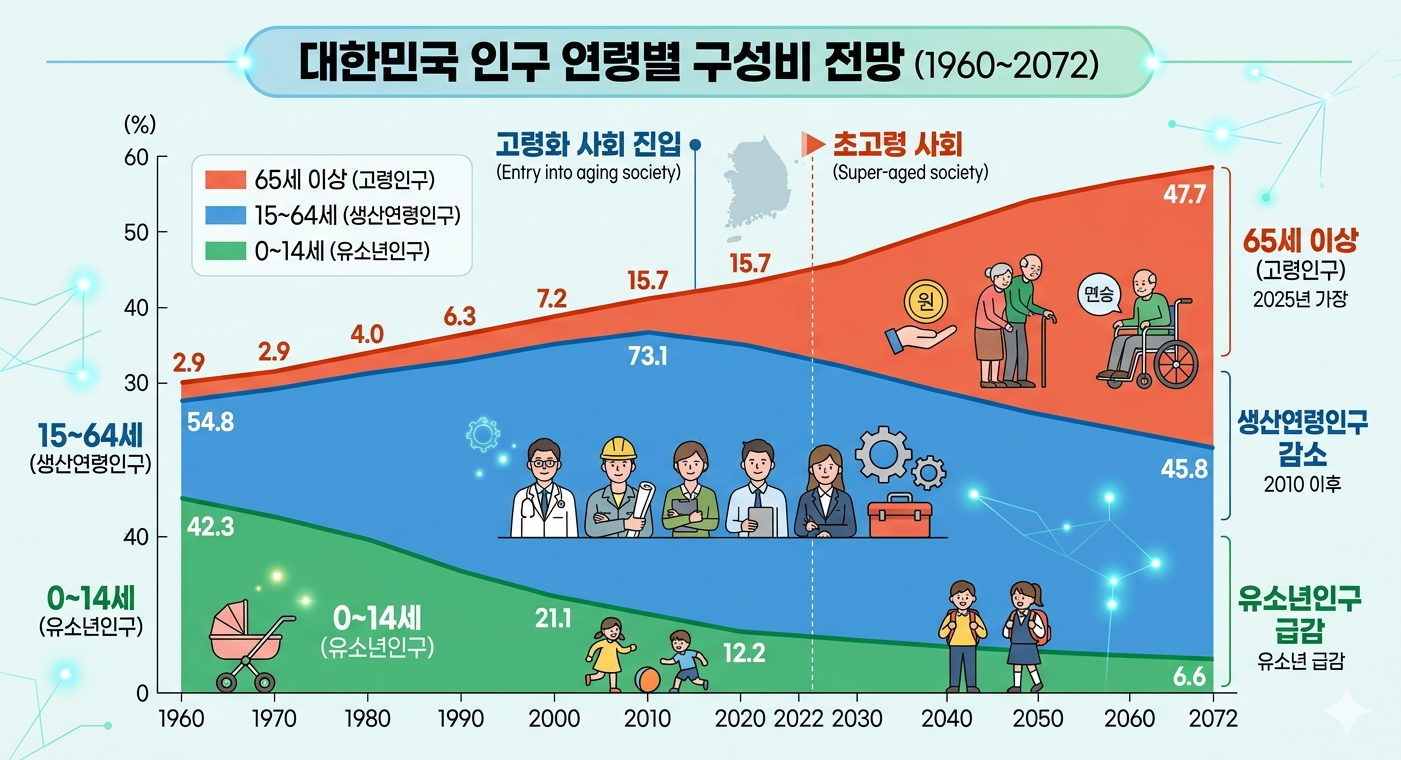
Created by Gemini (May 2, 2026)
자료 출처: 한국 국가데이터처 (KOSIS) https://kosis.kr/visual/populationKorea/PopulationDashBoardDetail.do?statJipyoId=3734&vStatJipyoId=5386&listId=A_01&areaId=&areaNm=
어휘와 표현
1. 고령화 – population aging
2. 현황 – current status
3. 인구 – population
4. 연령별 – by age group
5. 구성비 – proportion
6. 전망 – forecast
7. 단위 – unit
8. 통계청 – National Statistical Office (Korea's official statistics agency)
듣기
어휘와 표현
1. 교양 – culture, liberal arts
2. 초저출산 – ultra-low birth rate
3. 개발도상국 – developing country
4. 전환 – transition
5. 고용 – employment
6. 출산율 저하 – decline in birth rate
7. 인구 감소 – population decline
8. 고도 성장 – high growth
9. 정책 – policy
10. 예산 – budget
11. 확신 – conviction, confidence
12. 속도 – pace, speed
13. 범위 – range, scope
14. 규모 – scale, size
15. 제도 – system, institution
16. 평균 – average
17. 지역별 – by region
18. 지속되다 – to continue, persist
19. 그럼에도 불구하고 – nevertheless, despite that
20. 안정적이다 – stable
21. 합리적이다 – rational, reasonable
22. 효율적이다 – efficient
23. 제한적이다 – limited
24. 고정적이다 – fixed, static
25. 물가의 지속적 상승 – continuous rise in prices, inflation
26. 보조금 지원 – subsidy support
27. 의사결정을 내리다 – to make a decision
28. 육아 휴직 – parental/childcare leave
29. 미미하다 – minimal, insignificant
30. -을/를 향해 달려가다 – to head toward (rapidly)
31. 노동 격차 – labor gap, employment disparity
32. 본능 – instinct
33. 부작용 – side effect, adverse effect
34. 발생하다 – to occur, happen
35. 소위 – so-called
36. 증발분 – evaporated portion/loss
37. 전교 1등 – top student in the entire school
38. 평균을 갉아먹다 – to pull down the average
39. 골머리를 앓다 – to struggle with, to be troubled by
40. 공고하다 – solid, firm, strong
41. 고밀도 공간 – high-density space
42. 근로소득 – earned income, wage income
43. 수식어 – modifier, descriptive word
44. 직결 – direct connection
45. 모태 – origin, womb, foundation
46. 불리하다 – disadvantageous
47. 팍팍하다 – tough, harsh (often used for life conditions)
48. NOUN마저 – even NOUN (to emphasize something surprising or extreme)
49. 여력 – capacity, resources, means (often meaning 'room to spare')
50. 투입 – input, investment
51. 근원 변수 – fundamental variable
52. 재정 – finance
53. 자본 – capital
54. 배분하다 – to distribute, allocate
55. 부가가치 – added value
56. 총량 – total amount
57. 골칫덩이 – nuisance, troublemaker, headache
58. 역기술 – reverse engineering
59. 역발상 – thinking in reverse, unconventional thinking
60. 분해하다 – to disassemble, break down
61. 모형 – model, prototype
62. 후발자 – latecomer, follower (as opposed to pioneer)
63. 추격하다 – to chase, catch up
64. 조세제도 – tax system
65. 복지제도 – welfare system
66. 세대 부조형 – intergenerational imbalance
67. 설계화 – systematization
68. 전대미문의 사태 – unprecedented situation
69. 어긋나다 – to go wrong, deviate, be out of sync
70. -라는 전제가 붙다 – to come with the premise that
71. 반등 – rebound, recovery (often economic)
72. 전환의 기회 – opportunity for transition, turning point
73. 주가 – stock price
74. 우상향 – upward trend, rising trend
75. 국민 연금 – national pension
76. 운용하다 – to manage, operate (funds, systems, etc.)
77. 노후 준비 – retirement preparation
78. 고갈되다 – to be depleted, run out
79. 집합점 – convergence point
80. 돌파구 – breakthrough, way out
다음 두 어휘의 차이점을 설명해 보세요.
듣기 이해
As you watch the YouTube video again, answer the following questions in English.
어휘와 표현
1. 교양 – culture, liberal arts
2. 초저출산 – ultra-low birth rate
3. 개발도상국 – developing country
4. 전환 – transition
5. 고용 – employment
6. 출산율 저하 – decline in birth rate
7. 인구 감소 – population decline
8. 고도 성장 – high growth
9. 정책 – policy
10. 예산 – budget
11. 확신 – conviction, confidence
12. 속도 – pace, speed
13. 범위 – range, scope
14. 규모 – scale, size
15. 제도 – system, institution
16. 평균 – average
17. 지역별 – by region
18. 지속되다 – to continue, persist
19. 그럼에도 불구하고 – nevertheless, despite that
20. 안정적이다 – stable
21. 합리적이다 – rational, reasonable
22. 효율적이다 – efficient
23. 제한적이다 – limited
24. 고정적이다 – fixed, static
25. 물가의 지속적 상승 – continuous rise in prices, inflation
26. 보조금 지원 – subsidy support
27. 의사결정을 내리다 – to make a decision
28. 육아 휴직 – parental/childcare leave
29. 미미하다 – minimal, insignificant
30. -을/를 향해 달려가다 – to head toward (rapidly)
31. 노동 격차 – labor gap, employment disparity
32. 본능 – instinct
33. 부작용 – side effect, adverse effect
34. 발생하다 – to occur, happen
35. 소위 – so-called
36. 증발분 – evaporated portion/loss
37. 전교 1등 – top student in the entire school
38. 평균을 갉아먹다 – to pull down the average
39. 골머리를 앓다 – to struggle with, to be troubled by
40. 공고하다 – solid, firm, strong
41. 고밀도 공간 – high-density space
42. 근로소득 – earned income, wage income
43. 수식어 – modifier, descriptive word
44. 직결 – direct connection
45. 모태 – origin, womb, foundation
46. 불리하다 – disadvantageous
47. 팍팍하다 – tough, harsh (often used for life conditions)
48. NOUN마저 – even NOUN (to emphasize something surprising or extreme)
49. 여력 – capacity, resources, means (often meaning 'room to spare')
50. 투입 – input, investment
51. 근원 변수 – fundamental variable
52. 재정 – finance
53. 자본 – capital
54. 배분하다 – to distribute, allocate
55. 부가가치 – added value
56. 총량 – total amount
57. 골칫덩이 – nuisance, troublemaker, headache
58. 역기술 – reverse engineering
59. 역발상 – thinking in reverse, unconventional thinking
60. 분해하다 – to disassemble, break down
61. 모형 – model, prototype
62. 후발자 – latecomer, follower (as opposed to pioneer)
63. 추격하다 – to chase, catch up
64. 조세제도 – tax system
65. 복지제도 – welfare system
66. 세대 부조형 – intergenerational imbalance
67. 설계화 – systematization
68. 전대미문의 사태 – unprecedented situation
69. 어긋나다 – to go wrong, deviate, be out of sync
70. -라는 전제가 붙다 – to come with the premise that
71. 반등 – rebound, recovery (often economic)
72. 전환의 기회 – opportunity for transition, turning point
73. 주가 – stock price
74. 우상향 – upward trend, rising trend
75. 국민 연금 – national pension
76. 운용하다 – to manage, operate (funds, systems, etc.)
77. 노후 준비 – retirement preparation
78. 고갈되다 – to be depleted, run out
79. 집합점 – convergence point
80. 돌파구 – breakthrough, way out
토론
읽기
한겨레 2024년 6월 19일 기사
출처: https://www.hani.co.kr/arti/opinion/because/1145596.html
어휘와 표현
1. 저출산 – low fertility
2. 고령화 – aging
3. 가족복지론 – Family Welfare Theory
4. 경력단절 – career break
5. 가부장적이다 – to be patriarchal
6. 책임지다 – to take responsibility
7. -다/(이)라는 가정 아래 – under the assumption that
8. 주 NOUN – main NOUN
9. 양육자 – caregiver
10. 고학력 – highly educated
11. 언론인 – journalist
12. 커리어를 쌓다 – to build a career
13. 입장차 – difference in perspective
14. 극명하다 – to be clear, stark
15. 출산휴가 – maternity leave
16. 육아휴직 – parental leave
17. 시행되다 – to be implemented
18. 상충하다 – to contradict, conflict
19. 노동력 – labor force
20. 보편적이다 – to be universal
21. 재분배 – redistribution
22. 취약가구 – vulnerable household
23. 한정되다 – to be restricted
24. 선별적이다 – to be selective
25. -다/(이)라는 문제점을 안고 있다 – to have the problem of
26. 한부모 가구 – single-parent household
27. 바닥 수준에 머물고 있다 – to remain at a rock-bottom level
28. 가족주의적이다 – to be familistic
29. 책정하다 – to allocate (budgets, fees, pay rates, etc.)
30. 양립 – coexistence
31. 지출하다 – to spend
32. 조세 – taxation
33. 감면하다 – to reduce
34. 돌봄 – care
35. 유연하다 – to be flexible
36. 조정하다 – to adjust
37. 추진하다 – to push forward
38. 담론을 형성하다 – to form a discourse
39. 수용도 – acceptance level
40. 아동수당 – child allowance
41. 빈곤 – poverty
42. 양성평등 – gender equality
43. 아동복지 – child welfare
44. 사회정의 – social justice
45. 향상 – improvement
46. 단축 – shortening
47. 방과 후 – after-school
48. 결혼이주여성 – female marriage immigrant
49. 이주노동자 – migrant worker
50. 고용률 – employment rate
51. 양극화 – polarization
52. 첫 단계 – first step
53. 꺼리다 – to avoid
54. 만만치 않다 – to be considerable
55. 성장하다 – to grow up
56. 손자녀 – grandchildren
57. 적용되다 – to be applied
58. 조만간 – sooner or later
59. 최저임금 – minimum wage
60. 지급하다 – to pay
61. 맞벌이 – dual-income family
62. 졸속 NOUN – hasty NOUN
63. -와/과 -을/를 병행하다 – to juggle, combine, parallel
64. 일반적이다 – to be common
65. 해결책 – solution, way out
66. 앞서 제시한 – previously presented
67. 참고하다 – to refer to
68. 시사점 – implications
69. -의 실정에 맞다 – to fit the actual conditions of
70. 지속가능하다 – to be sustainable
내용 이해하기
토론
찬반 논쟁
다음 의견에 찬성하세요, 아니면 반대하세요? 먼저 입장을 명확히 밝히고 왜 그렇게 생각하는지 설득력 있게 의견을 펼쳐 보세요.
1.결혼을 하지 않으면 “비정상”인가?
먼저 예시응답을 들어보고, 본인의 응답을 녹음해 보세요.
1번 예시응답
[예시 응답]
저는 결혼을 하지 않으면 "비정상"이라고 규정하는 시각에는 동의하기 어렵다고 느낍니다. 무엇보다도 '정상'과 '비정상'이라는 건 이분법적 범주인데, 이렇게 생각하게 되면 개인의 삶의 방식을 획일화할 위험이 있다고 생각합니다. 현대 사회에는 다양한 가치관과 삶의 형태가 존재하는데 이런 이분법적인 사고는 현대 사회를 충분히 반영하지 못합니다. 결혼은 개인의 선택에 기반한 삶의 한 방식일 뿐이고, 그것이 인간의 성숙도나 사회적 기여도를 판단하는 절대적 기준이 될 수는 없다고 생각합니다. 실제로 오늘날에는 직업적 성취나, 개인의 자아실현, 공동체 참여 등 다양한 방식으로 의미있는 삶을 구축하는 사람들이 많지 않습니까? 이런 사람들은 결혼 여부와 무관하게 사회에 바람직하고 긍정적인 영향을 미치고 있습니다. 따라서 결혼을 하지 않는 선택을 '비정상'으로 보기보다는, 각 개인이 처한 상황과 가치관을 존중하는 방향으로 사회적 인식이 전환될 필요가 있다고 봅니다.